
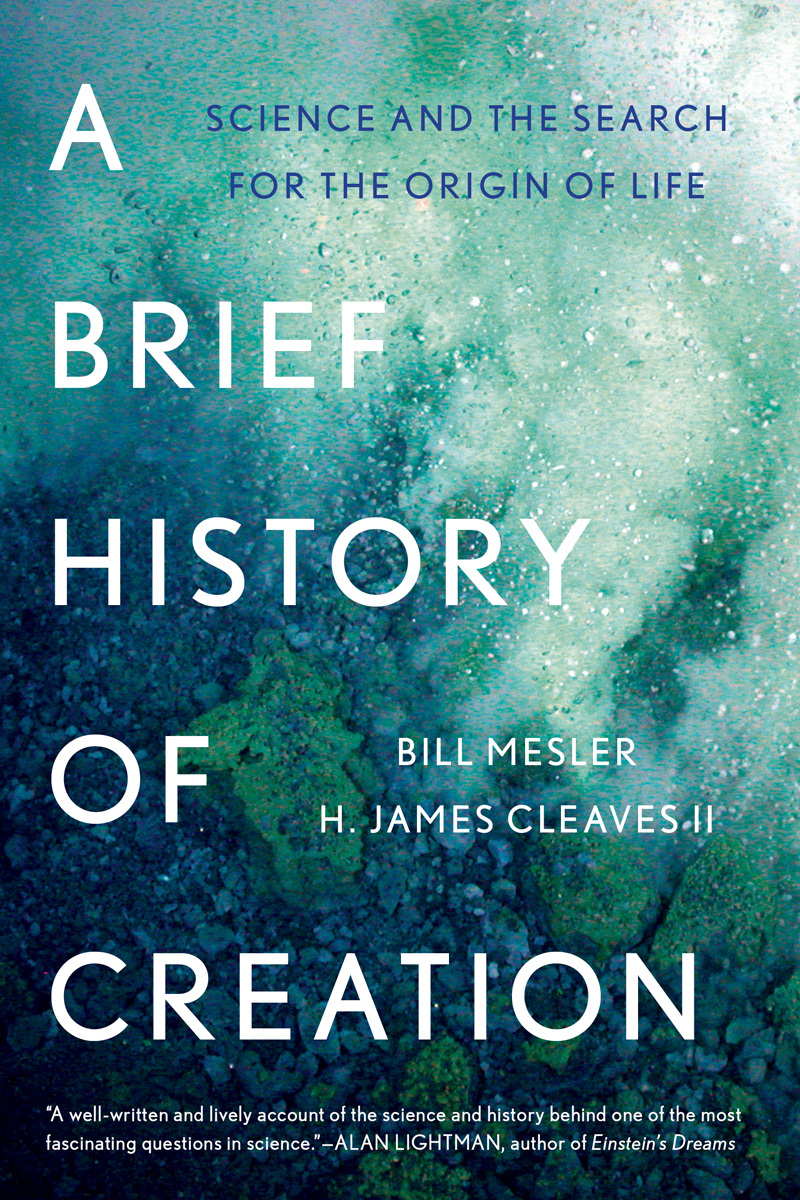
A Brief History of Creation: Science and the Search for the Origin of Life
Academic Book Review
A Brief History of Creation: Science and the Search for the Origin of Life
Rating: ★★★★☆ (4 out of 5 stars)
Disclaimer: I was provided a complimentary copy of this book from the publisher for review purposes. This provision has in no way affected the content, objectivity, or critical analysis of this review.
Publication and Context
- Title: A Brief History of Creation: Science and the Search for the Origin of Life
- Authors: Bill Mesler and H. James Cleaves II
- Edition: 1st Paperback Edition
- Publication Date: December 6, 2016 (First published December 1, 2015)
- Publisher: W. W. Norton & Company
- Page Count: 336 pages
- ISBN-10 / ISBN-13: 0393353192 / 978-0393353198
- Genre: Science / Nonfiction / History of Biology / Philosophy
- Target Audience: Academics, science historians, and educated lay readers interested in evolutionary biology and the philosophy of science.
Publication Context and Author Background:
Arriving at a time when astrobiology and genetic engineering are pushing the boundaries of what we define as “life,” this text bridges historical philosophy and modern biochemistry. Bill Mesler, a seasoned science journalist, and H. James Cleaves II, a prominent chemist and origin-of-life researcher, combine their expertise to deliver a narrative that is both scientifically rigorous and highly readable. The book sits comfortably alongside Nick Lane’s The Vital Question and Siddhartha Mukherjee’s The Gene, offering a historiographical approach to humanity’s most enduring biological mystery.
Purpose and Thesis of the Review
In my daily work parsing complex, often contradictory data to find the hidden truths—the “signal in the noise.” It is a skill equally required in public health policy and, frankly, in managing a household of four children, a clowder of cats, and an indoor jungle of demanding tropical plants.
My central thesis in reviewing A Brief History of Creation is that the book succeeds brilliantly not as a definitive scientific textbook, but as a study of tradecraft—the tradecraft of scientific inquiry. The authors argue that the search for life’s origins is as much a story of human philosophy, bias, and institutional dogma as it is a story of empirical discovery. I will evaluate the text based on its narrative architecture, the strength of its historical sourcing, and its ability to distill dense biochemical theories into accessible prose.
Summary of the Work
A Brief History of Creation traces the evolution of human thought regarding abiogenesis—how life arises from non-living matter. The narrative is structured chronologically, opening with the ancient Greeks (Anaximander and Aristotle) before moving through the Enlightenment, the Darwinian revolution, and into the modern era of the RNA world and deep-sea hydrothermal vents.
Without spoiling the intricacies of modern genomic discoveries, the authors carefully construct a narrative that moves from the concept of “spontaneous generation” (debunked by Redi and Pasteur) to Darwin’s “warm little pond,” and ultimately to the dark, high-pressure depths of the ocean. The book’s stated goal is to illuminate not just how life began, but how we have searched for the answer, interrogating the very nature of scientific objectivity along the way.
Analysis and Evaluation
Themes and Ideas
The book masterfully engages with the tension between vitalism (the idea that life possesses a mystical “spark”) and mechanistic chemistry. It is a thoughtful interrogation of its genre that leaves readers with surprising, resonant questions about what constitutes life itself.
Style and Craft
Mesler and Cleaves utilize rich, precise prose that rewards patient attention and rewards fresh interpretation. The prologue beautifully sets the stakes through a cinematic lens, describing the seafloor as “dark green, sloped like the outer edges of a huge jade dome, and cut by deep chasms and steep ravines” (Preface). This sensory detail makes the abstract concept of abiogenesis feel immediate and tangible. The authors employ elegant and economical language, proving that restraint can illuminate complexity rather than obscure it.
Argument and Evidence
As a public health professional accustomed to rigorous epidemiological evidence, I appreciated how the authors map the evolution of the scientific method. They detail how theories were built, championed, and eventually discarded. For example, the shift from Stanley Miller’s “primordial soup” lightning experiments to Mike Russell’s “hydrothermal garden” is presented not as a failure of early science, but as a necessary stepping stone. The logic is sound, and the historical documentation is robust.
Representation and Inclusivity
While the history of Western science is predominantly populated by white men, the authors make a concerted effort to highlight overlooked figures. The preface prominently features geologists Barbara John and Gretchen Früh-Green steering the Argo to discover the “Lost City” hydrothermal vents. However, the text occasionally falters by not fully exploring the indigenous or non-Western cosmologies that predated European scientific thought—a minor limitation in an otherwise comprehensive work.
Strengths and Weaknesses
- Strengths: The book pairs accessibility with ambition, inviting broader readership without compromising depth. The seamless integration of history, philosophy, and chemistry is remarkable. It is a rare blend of immediacy and craft that makes the ordinary feel urgent.
- Weaknesses: For specialists with advanced graduate degrees in the hard sciences, the later chapters on the RNA world may feel somewhat abbreviated. The book prioritizes historical narrative over deep-dive molecular biology, which is appropriate for its target audience but may leave academics hungry for heavier data.
Evidence and Support
The authors frame the entire endeavor through the lens of human curiosity, aptly opening with Mary Shelley’s Frankenstein: “It was the secrets of heaven and earth that I desired to learn…” (Preface).
Through close reading, one can see how the authors use physical landscapes to mirror theoretical breakthroughs. The discovery of the towering, 180-foot hydrothermal pinnacles of the Lost City by John and Früh-Green serves as a profound metaphor for the shift in scientific consensus. Mike Russell’s realization that life required an environment “shielded from constant bombardment by meteorites and solar ultraviolet radiation” (Preface) demonstrates the book’s core method: linking geological realities to biological origins.
Contextual Analysis & Comparisons
Published in the mid-2010s, this work arrived during a renaissance of popular science writing aimed at a public increasingly skeptical of scientific institutions. A work that not only tells a story but reframes how we talk about its themes, this book serves as a vital reminder of the iterative, self-correcting nature of science.
Comparisons:
- Compared to Bill Bryson’s A Short History of Nearly Everything: Mesler and Cleaves offer a much more focused, philosophically grounded narrative, though with slightly less comedic levity.
- Compared to Robert Hazen’s Genesis: The Scientific Quest for Life’s Origin: This book leans heavier into the historical personalities and the friction between competing scientists, making it a more character-driven read.
Suitability and Audience Guidance
- Reading Level & Best-Fit Audience: Appropriate for educated lay readers, undergraduate students, and professionals in adjacent fields (like health policy or administration). It requires no advanced degree in biochemistry to understand, making it highly accessible.
- Content Warnings: None. Suitable for all audiences.
- Practical Considerations: Available in print, e-book, and audiobook. At 336 pages, the pacing is brisk. The inclusion of an Appendix (“Recipes for Life”), robust notes, and a bibliography make it an excellent reference text.
Conclusion and Verdict
A Brief History of Creation is a drama of language and memory that lingers long after the last page. By chronicling the missteps, the rivalries, and the profound epiphanies of those who sought to understand our beginnings, Mesler and Cleaves have crafted a deeply humanistic view of the scientific method.
Final Recommendation: I highly recommend this book for science enthusiasts, policy makers, and anyone who appreciates a well-researched intellectual history. It offers a doorway to a larger conversation about our place in the cosmos, inviting readers to step through.
Stakes and Broader Significance:
In an era where scientific fact is frequently politicized, understanding how we know what we know is just as critical as the knowledge itself. This book matters because it demystifies the scientific process, showing it not as a monolithic dispenser of absolute truths, but as a messy, beautiful, and deeply human quest.
Supplementary Elements: Buyer’s Guide & What to Read Next
Discussion Prompts for the Classroom or Book Club:
- How did the prevailing religious and cultural dogmas of each era dictate the hypotheses scientists were willing to entertain regarding the origin of life?
- Compare Darwin’s “warm little pond” to Mike Russell’s “hydrothermal garden.” How does the shift in setting change our understanding of early Earth?
What to Read Next:
- The Vital Question: Energy, Evolution, and the Origins of Complex Life by Nick Lane (For a deeper, more technical dive into cellular energy and the origin of life).
- The Gene: An Intimate History by Siddhartha Mukherjee (For readers who enjoyed the historical and biographical approach to biological science).
- Lab Girl by Hope Jahren (For readers looking for a personal, memoir-driven look at the life of a female scientist—and an excellent companion piece for fellow plant lovers!).
Rating: ★★★★ 4.0 / 5
- Prairie Fox 🦊📖

.HEIC)
.jpg)
Comments
Post a Comment