
Homo Deus: A History of Tomorrow
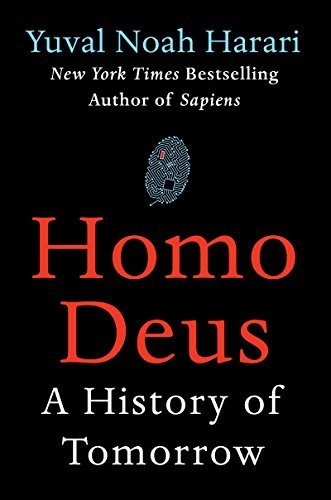
Homo Deus: A History of Tomorrow
By Yuval Noah Harari
Genre: Nonfiction / History / Philosophy / Science
Publication Year: 2015
My Rating: ★★★★☆ (4/5)
Spoiler Preference: Spoiler-Free
When Humanity Becomes Its Own Greatest Question
Some books ask us to look backward in order to understand who we are. Others ask us to look forward and consider who we might become. Homo Deus belongs firmly in the second category, though it cannot resist revisiting the past along the way.
Reading this book felt like sitting in a coffee shop with an exceptionally brilliant, occasionally provocative, and sometimes frustrating conversation partner. Every few pages, Yuval Noah Harari offers an observation so surprising or unsettling that I found myself pausing, staring into my coffee, and wondering whether I agreed with him at all. That, ultimately, is one of the book's greatest strengths. Whether Harari's predictions prove accurate is almost beside the point. He compels readers to grapple with questions that many of us would rather postpone.
What happens if humanity successfully conquers its traditional enemies of famine, plague, and large-scale war? What ambitions emerge when survival is no longer our primary concern? If artificial intelligence and biotechnology increasingly shape human life, what becomes of human freedom, meaning, and dignity?
These are not merely technological questions. They are philosophical, political, ethical, and deeply personal ones. Harari's achievement lies in bringing them together into a sweeping narrative about the future of our species.
Reframing Humanity's Future
Following the enormous success of Sapiens, Harari turns his attention from humanity's past to its possible futures. His central argument is that humanity is entering a new era in which technological and scientific advances may fundamentally alter what it means to be human.
According to Harari, the great historical projects of reducing famine, controlling disease, and limiting violence have been successful enough that new priorities are emerging. He suggests that future societies may increasingly focus on extending life, enhancing human capabilities, and perhaps even transcending biological limitations altogether.
The book explores several interconnected themes: artificial intelligence, biotechnology, data science, consciousness, economic transformation, and the future of political systems. Harari argues that the combination of massive data collection and increasingly powerful algorithms could challenge many assumptions that modern liberal societies take for granted, particularly the belief in individual autonomy and free choice.
Unlike traditional futurists who focus primarily on technological developments, Harari attempts something more ambitious. He asks how technology might reshape the stories humans tell themselves about identity, morality, religion, and meaning.
The result is an intellectually exhilarating work, though one that occasionally sails close to speculative overreach.
The Public Health Perspective: Progress and Its New Risks
From a public health perspective, Homo Deus raises fascinating questions about how societies define success.
Historically, public health has focused on extending life, reducing suffering, and improving population well-being. By many measures, humanity has achieved extraordinary progress. Life expectancy has risen dramatically across much of the world. Many infectious diseases that once devastated populations have become manageable or preventable. Extreme poverty has declined globally, though unevenly.
Harari asks what happens after those achievements.
This is where the book becomes particularly relevant to public health practitioners. Much of modern health leadership increasingly concerns chronic disease, aging populations, mental health challenges, misinformation, climate impacts, and unequal access to technological advances. In this sense, Harari correctly identifies a transition from problems of scarcity to problems of management, distribution, and governance.
Yet I sometimes felt the book underestimates how incomplete our victories remain.
While famine, infectious disease, and violence may have declined in many places, they continue to shape life for millions around the world. Reading from the vantage point of public health, it is difficult to fully embrace the notion that humanity has "solved" these challenges. Progress has been substantial, but it remains unevenly distributed.
The book is at its strongest when examining how new technologies could deepen existing inequalities. Advanced therapies, genetic enhancement, and artificial intelligence may improve lives dramatically, but they may also widen gaps between wealthy and disadvantaged populations if access remains unequal.
As a public health professional, I appreciated Harari's willingness to think at the systems level. Health outcomes are never simply products of individual choices. They emerge from institutions, incentives, infrastructure, and political decisions. The same principle applies to the technological future Harari describes. The question is not merely what technology can do. The question is who controls it, who benefits from it, and who bears its risks.
Looking Through an Intelligence and Analytic Lens
One reason Homo Deus has generated both admiration and criticism is that Harari often moves rapidly between established evidence and broad speculation.
From an analytic perspective, this creates both the book's greatest strength and its most significant weakness.
Harari excels at identifying emerging trends and connecting developments across disciplines. His discussions of algorithmic decision-making, data collection, surveillance, and artificial intelligence feel particularly prescient. In many cases, events since the book's publication have made these concerns more rather than less relevant.
At the same time, readers should approach some of his conclusions with caution.
Harari frequently constructs sweeping narratives that connect technology, economics, biology, and culture. These frameworks are intellectually stimulating, but they sometimes rely on assumptions that deserve greater scrutiny. Alternative interpretations often exist, and historical developments rarely unfold as predictably as large theories suggest.
One of the most valuable lessons I took away from the book concerns uncertainty itself.
Analysts are trained to distinguish between what is known, what is likely, and what is merely possible. Harari's most persuasive arguments operate in the first two categories. His more dramatic predictions often occupy the third.
That does not make them wrong. It simply means readers should recognize the difference between evidence-based forecasting and provocative thought experiments.
Interestingly, Harari appears less interested in predicting the future with precision than in preparing readers to think seriously about it. In that respect, the book succeeds admirably.
Meaning, Family, and Midlife Reflections
Reading Homo Deus in midlife felt substantially different than it might have twenty years ago.
When I was younger, I likely would have focused primarily on the technological possibilities. Now I found myself drawn more to the book's questions about meaning.
If life can be extended indefinitely, what makes a life meaningful?
If algorithms make better decisions than humans, what becomes of human judgment?
If efficiency becomes our highest value, what happens to relationships, traditions, and ordinary moments of care?
As a wife and mother, I found myself evaluating Harari's future not simply through the lens of innovation but through the lens of human connection. Technological progress undoubtedly matters. Yet some of life's most important experiences resist quantification. The late-night conversation with a child. The shared history between spouses. The comfort of friendship. The rituals that help communities endure hardship.
Harari sometimes writes as though technological change inevitably drives social transformation. While there is truth in that observation, I found myself wondering whether he occasionally undervalues humanity's remarkable attachment to meaning-making traditions.
People do not live by information alone.
We live by relationships, stories, obligations, hopes, and memories.
To his credit, Harari recognizes this tension. The book repeatedly returns to the question of whether humanist values can survive a world increasingly shaped by data-driven systems.
That question remains unresolved, which may be precisely why it is so important.
Strengths and Limitations
The book's greatest strength is its ambition.
Few authors attempt to synthesize history, technology, biology, economics, philosophy, and political theory into a single narrative. Harari does so with remarkable clarity and accessibility. Complex ideas are generally presented in language that educated general readers can understand.
The book is also extraordinarily thought-provoking. Even when I disagreed with Harari, I found myself engaging deeply with his arguments. That is often the hallmark of worthwhile nonfiction.
Another strength is the author's ability to identify long-term implications of emerging trends. Discussions of artificial intelligence, algorithmic governance, and data concentration feel particularly relevant today.
However, the book's weaknesses stem from the same qualities that make it compelling.
Harari occasionally prioritizes grand narratives over nuance. Some arguments feel more confident than the available evidence warrants. Specialists in various fields have criticized aspects of his historical interpretations and scientific assumptions, and readers should recognize that many of the book's claims remain subjects of active debate.
Additionally, the sheer scope of the project sometimes leads to oversimplification. Entire philosophical traditions, political movements, and scientific controversies are occasionally condensed into surprisingly brief discussions.
These limitations do not undermine the book's value, but they encourage readers to treat it as a starting point for inquiry rather than a definitive guide to the future.
Final Thoughts
Homo Deus is not a prophecy. It is a provocation.
Harari invites readers to imagine a future in which humanity gains unprecedented power while simultaneously confronting profound questions about identity, freedom, and purpose. Some predictions may ultimately prove misguided. Others may prove alarmingly accurate. Most likely, reality will unfold somewhere in between.
What makes the book memorable is not its certainty but its willingness to wrestle with uncertainty.
For readers interested in technology, public policy, ethics, artificial intelligence, public health, or the future of democratic societies, Homo Deus offers an intellectually rich and engaging experience. Even those who reject many of Harari's conclusions will likely find themselves challenged by his questions.
Long after finishing the final chapter, I kept returning to a simple realization: humanity's greatest challenge may no longer be conquering the world around us. It may be deciding what kind of people we wish to become once we have the power to reshape ourselves.
That is a far more difficult problem than any technological breakthrough can solve.
Rating: ★★★★☆ (4/5)
Coffee Pairing: A complex Ethiopian pour-over, bright, layered, occasionally surprising, and best enjoyed slowly while pondering questions without easy answers.

.HEIC)

.jpg)
Comments
Post a Comment