
Sisters in Science
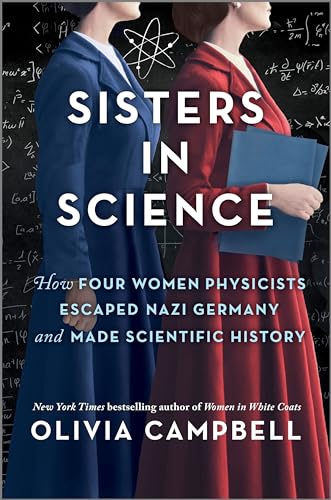
Sisters in Science
By Olivia Campbell
Genre: History / Biography / Science
Publication Year: 2024
My Rating: ★★★★☆ (4/5)
Spoiler Preference: Spoiler-Free
Genius, Exile, and the Cost of Being Unwelcome
History often celebrates scientific breakthroughs while overlooking the people who fought simply to remain in the room where discovery was happening.
That is what makes Sisters in Science such a compelling and, at times, infuriating read.
Olivia Campbell tells the intertwined stories of four pioneering physicists, Hedwig Kohn, Lise Meitner, Hertha Sponer, and Hildegard Stücklen, whose careers unfolded during one of the most dangerous periods of the twentieth century. These women were not aspiring scientists hoping for an opportunity. They were accomplished physicists already contributing to their field when the rise of Nazism threatened not only their careers but their lives.
The book is, in one sense, a story of scientific achievement. Yet it is equally a story about forced migration, institutional discrimination, friendship, resilience, and the extraordinary effort required for talented women simply to continue doing the work they loved.
Reading it, I found myself repeatedly reminded that progress is rarely inevitable. Scientific advancement depends not only on intelligence and curiosity but also on whether societies choose to nurture talent or drive it away.
Four Women, One Historical Catastrophe
Campbell structures the book around the lives of four physicists whose paths diverged dramatically after the Nazi rise to power.
Some were targeted because they were Jewish. Others because they opposed the regime or fell outside its vision of who belonged in academia. Regardless of the specific circumstances, all faced a devastating reality: the institutions to which they had devoted their careers no longer wanted them.
The narrative follows their increasingly desperate efforts to escape Germany and rebuild their lives elsewhere.
Among the four women, Lise Meitner is perhaps the most familiar name to modern readers because of her crucial contributions to nuclear physics. Campbell wisely resists turning the book into a single biography, however. Instead, she places Meitner's story alongside those of Kohn, Sponer, and Stücklen, illustrating both the common challenges they faced and the distinct ways each woman responded.
This broader perspective is one of the book's greatest strengths.
Readers come away understanding that discrimination was not merely a series of isolated injustices. It was a systemic assault on an entire generation of scientific talent.
The tragedy extends beyond individual lives. The scientific community itself suffered enormous losses when political extremism displaced some of its brightest minds.
A Public Health Perspective: The Human Cost of Exclusion
From a public health perspective, Sisters in Science functions as a powerful reminder that policies and institutions profoundly affect human well-being.
Public health professionals often discuss social determinants of health, the conditions in which people live, work, learn, and age. Academic institutions may not immediately come to mind in that conversation, yet the book demonstrates how deeply they shape opportunities, security, and quality of life.
The women profiled here were not simply denied jobs.
They were stripped of professional identities, financial stability, community connections, and personal safety. In many cases, they faced prolonged uncertainty about whether they would find refuge anywhere at all.
The psychological toll of displacement permeates the narrative. So does the importance of social support networks. Friends, colleagues, mentors, and fellow scientists repeatedly emerge as critical sources of assistance.
One lesson feels particularly relevant today: talent is universal, but opportunity is not.
Societies pay a significant price when barriers prevent capable individuals from contributing fully. That lesson applies not only to historical discrimination but also to contemporary conversations about access to education, immigration, gender equity, and workforce development.
Campbell does an excellent job illustrating how exclusion harms not only the excluded but the broader communities that lose their contributions.
Looking Through an Analytic Lens
One of the most fascinating aspects of the book is how clearly it demonstrates the relationship between politics and knowledge.
Scientific institutions are often portrayed as objective spaces governed purely by evidence and merit. Sisters in Science reveals how fragile that ideal can be.
The women in this book encountered obstacles that had little to do with competence and everything to do with ideology, prejudice, and power. Their experiences underscore an important analytical principle: institutions frequently make decisions based on factors that are unrelated to their stated missions.
As someone inclined to examine systems, assumptions, and incentives, I found this aspect particularly compelling.
The Nazi regime's removal of Jewish and politically suspect scientists is often discussed primarily as a moral catastrophe, which it certainly was. Campbell also highlights its strategic irrationality. Germany systematically undermined its own intellectual infrastructure by driving away individuals whose knowledge and expertise represented irreplaceable assets.
The book therefore functions on multiple levels: biography, history, and cautionary tale.
It also raises important questions about attribution and recognition. Readers familiar with the history of physics may be aware that some contributions by women scientists received less acknowledgment than comparable work by male colleagues. Campbell handles these issues thoughtfully, avoiding simplistic narratives while clearly illustrating patterns of inequity.
Reading This Book as a Woman in Midlife
As a woman reading this book in midlife, I found myself drawn less to the scientific details than to the persistence of the women at its center.
The obstacles they faced were enormous.
Yet what impressed me most was not their brilliance, although that is undeniable. It was their determination to continue.
Again and again, opportunities disappear. Positions vanish. Countries become unsafe. Professional recognition evaporates. Still, they adapt, relocate, rebuild, and carry on.
There is something deeply inspiring in that kind of resilience.
Many women, regardless of profession, understand the experience of having abilities underestimated or accomplishments overlooked. The stakes faced by these four physicists were obviously far more severe, but the underlying themes retain contemporary relevance.
The book also resonated with me as a mother.
Reading about these women, I found myself thinking about the talented young women entering scientific fields today. Their opportunities are unquestionably broader than those available to earlier generations, yet the story reminds us that progress should never be taken for granted.
Rights, access, and recognition are achievements that require maintenance.
History demonstrates how quickly they can disappear.
Strengths and Limitations
The book's greatest strength is its subject matter.
The stories of Kohn, Meitner, Sponer, and Stücklen deserve a wider audience, and Campbell succeeds in bringing their experiences to life. The research is thorough, and the narrative frequently reads with the momentum of a historical novel.
Another strength is the decision to tell four interconnected stories rather than focus exclusively on the most famous figure. This broader approach illuminates shared patterns while preserving individual complexity.
Campbell also excels at making scientific figures feel human. Readers do not need an advanced background in physics to appreciate the challenges these women faced or the significance of their achievements.
The book's primary limitation is one common to many group biographies. With four subjects sharing narrative space, readers occasionally receive less depth on individual lives than they might in a full-length biography devoted to a single scientist.
Similarly, some of the scientific discussions are necessarily streamlined in favor of maintaining narrative momentum. Readers seeking extensive technical explanations of the underlying physics may find the treatment relatively introductory.
For most audiences, however, these choices improve readability rather than detract from it.
Final Thoughts
Sisters in Science is ultimately a story about excellence under pressure.
Olivia Campbell shines a well-deserved spotlight on four remarkable women whose lives were shaped by both scientific discovery and political upheaval. In doing so, she reminds readers that the history of science is not merely a history of ideas. It is also a history of institutions, prejudice, opportunity, and resilience.
The book will appeal to readers interested in women's history, World War II, scientific biography, Jewish history, and the complex relationship between politics and knowledge. It is particularly valuable for anyone who enjoys uncovering overlooked stories that help complete our understanding of the past.
What lingered with me after finishing was not a particular scientific discovery but a broader realization. These women changed physics not because circumstances were favorable. They changed it despite circumstances that repeatedly told them they did not belong.
That they persevered is extraordinary.
That their stories remain relatively unfamiliar is precisely why books like Sisters in Science matter.
Rating: ★★★★☆ (4/5)
Coffee Pairing: A strong Viennese-style coffee, rich, resilient, and best enjoyed while reflecting on the minds history almost lost and the discoveries the world nearly never received.


Comments
Post a Comment