
How to Kill a Witch: The Patriarchy's Guide to Silencing Women
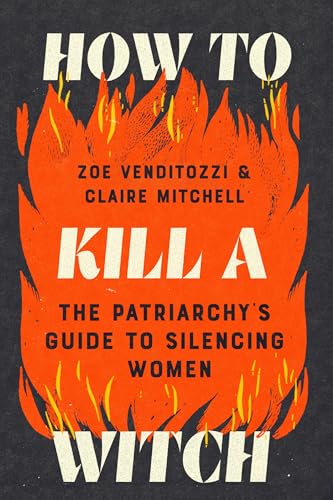
How to Kill a Witch: The Patriarchy's Guide to
Silencing Women
By Zoe Venditozzi and Claire Mitchell
Genre: History / Feminism / Nonfiction
Publication Year: 2025
My Rating: ★★★★☆ (4/5)
Spoiler Preference: Spoiler-Free
The Real Horror Was Never Magic
The enduring appeal of witch stories often lies in the supernatural. We imagine curses, spells, secret knowledge, and dark rituals. Yet one of the most unsettling lessons of How to Kill a Witch is that actual witch hunts required very little belief in magic and a great deal of belief in power.
Zoe Venditozzi and Claire Mitchell take readers into the machinery of Scotland's witch trials not to revisit folklore, but to expose a system designed to identify, isolate, condemn, and eliminate inconvenient women. Despite the book's darkly humorous title and occasional wit, this is ultimately a serious examination of how institutions can transform fear, prejudice, and social anxiety into legally sanctioned persecution.
What struck me most while reading was not the unfamiliarity of the events but their unsettling familiarity. The details may belong to sixteenth- and seventeenth-century Scotland, but the underlying mechanisms of scapegoating, misinformation, moral panic, and institutionalized bias remain deeply recognizable.
This is history that feels uncomfortably contemporary.
How a Society Manufactures Witches
The book focuses on Scotland's witch trials following the Witchcraft Act of 1563, examining how accusations developed, how investigations were conducted, and how legal systems were used to legitimize persecution.
Venditozzi and Mitchell's central argument is straightforward: witch hunts were not isolated outbreaks of superstition but organized systems of social control that disproportionately targeted women. By carefully reconstructing the bureaucratic processes behind accusations, interrogations, trials, and executions, they demonstrate that these events were neither random nor inevitable.
One of the book's greatest strengths is its emphasis on process.
Readers learn not only that women were accused of witchcraft, but how accusations evolved into convictions. The authors reveal a chillingly methodical sequence of events involving rumors, community tensions, coercive questioning, dubious evidence, and legal procedures designed to secure predetermined outcomes.
The inclusion of trial records, witness testimony, and historical documents provides valuable texture. Rather than treating victims as abstract statistics, the book restores individuality to people whose voices were often excluded from official narratives.
The result is an account that is both educational and deeply unsettling.
A Public Health Perspective: Fear as a Social Contagion
Reading How to Kill a Witch through a public health lens was particularly illuminating.
Public health is often associated with disease prevention, vaccination programs, or health promotion, but it also examines how communities respond to fear, uncertainty, and perceived threats. In many ways, the witch hunts described in this book functioned as a form of social contagion.
Periods of economic instability, food shortages, religious conflict, and political upheaval created fertile conditions for collective anxiety. Communities sought explanations for suffering, and vulnerable individuals became convenient targets.
What emerges is a powerful reminder that social conditions matter. People do not make decisions in a vacuum. Fear spreads through populations much as misinformation does today. Communities experiencing stress frequently look for simple explanations to complex problems, particularly when those explanations identify a specific group to blame.
The book repeatedly demonstrates how structural factors shaped outcomes. Women who occupied marginal social positions often faced heightened risks. Poverty, age, independence, social isolation, and nonconformity could all become liabilities.
As someone with a public health background, I appreciated that the authors resist reducing these events to mere superstition. Instead, they situate witch trials within broader social systems that influenced who became vulnerable and why.
That perspective makes the historical analysis significantly more powerful.
Looking Through an Analytic Lens
From an analytical standpoint, one of the book's most compelling achievements is its examination of evidence, or more accurately, the absence of it.
The accused were frequently expected to prove negatives. They were asked to demonstrate they were not witches, often under conditions designed to make meaningful defense impossible. Confessions were extracted through coercion, assumptions were treated as facts, and rumors acquired the weight of evidence through repetition.
Readers with backgrounds in intelligence, law, investigations, or policy analysis will immediately recognize the dangers involved.
The book serves as an extended case study in what happens when confirmation bias becomes institutionalized.
Investigators assumed guilt and interpreted information accordingly. Ambiguous evidence became incriminating evidence. Contradictory information was discounted. Social narratives overwhelmed critical analysis.
One of the book's strongest implicit lessons is that flawed methodologies can produce highly organized but deeply inaccurate conclusions.
The accused women were not failed by a lack of procedure. They were failed by procedures designed to justify predetermined outcomes.
That distinction feels particularly relevant in an era when discussions about misinformation, institutional trust, and evidence-based decision-making occupy increasingly central places in public life.
Reading This Book as a Woman in Midlife
Some books feel historical.
Others feel personal.
Although How to Kill a Witch is rooted in events hundreds of years in the past, I found myself reading it through the lens of contemporary womanhood. As a middle-aged woman, wife, mother, and professional, I was continually struck by how often the women targeted by these systems were punished not for what they had done but for who they were perceived to be.
Many were outsiders.
Many were inconvenient.
Many failed to conform to social expectations.
Many simply lacked power.
That realization gave the book significant emotional weight.
The authors draw careful connections between historical and modern forms of misogyny without collapsing important differences between the two. They avoid simplistic claims that contemporary society is identical to sixteenth-century Scotland. Instead, they encourage readers to consider recurring patterns in how fear, authority, and gender interact.
Those connections are where the book feels strongest.
Reading with a cup of coffee nearby, I frequently found myself alternating between outrage and admiration. Outrage at the systems described. Admiration for the authors' determination to recover and preserve these histories.
Historical memory matters.
When societies forget how easily injustice can be normalized, they become vulnerable to repeating familiar mistakes.
Strengths and Limitations
The book's greatest strength is its accessibility.
Historical nonfiction can sometimes become dense or overly academic. Venditozzi and Mitchell have written a work that remains rigorously researched while staying approachable for general readers. Their writing frequently balances historical detail with moments of dark humor that make difficult material easier to absorb.
The authors also excel at connecting individual stories to larger social and legal systems. This broader perspective allows readers to understand not only what happened but why it happened.
Another significant strength is the book's feminist framework. Rather than treating women as passive victims, the authors emphasize the structures that constrained their lives while restoring attention to their experiences and humanity.
The primary limitation is that readers seeking a highly academic treatment of Scottish witch trials may occasionally wish for deeper engagement with competing historiographical perspectives. The authors clearly write with a particular interpretive framework, and while that framework is persuasive, some readers may want more extensive discussion of scholarly debates surrounding certain aspects of the period.
Additionally, the modern parallels occasionally feel more suggestive than fully developed. While many are compelling, a few could have benefited from additional nuance.
These limitations are relatively minor and do little to diminish the book's overall impact.
Final Thoughts
How to Kill a Witch is ultimately less about witches than about power.
Zoe Venditozzi and Claire Mitchell reveal how fear can be weaponized, how institutions can legitimize prejudice, and how societies can convince themselves that cruelty serves a righteous purpose. In doing so, they transform a familiar historical subject into a timely examination of authority, gender, justice, and collective responsibility.
Readers interested in women's history, legal history, feminism, social psychology, and the mechanisms of power will find much to admire here. The book succeeds both as an accessible introduction to Scotland's witch trials and as a thoughtful meditation on why these stories continue to matter.
The most haunting lesson is not that people once believed in witches.
It is that ordinary people, convinced they were defending society, built systems capable of destroying innocent lives and called it justice.
History offers many warnings.
This book makes sure we hear one of its most important.
Rating: ★★★★☆ (4/5)
Coffee Pairing: A strong Scottish breakfast tea's coffee equivalent, dark, bracing, and best consumed while contemplating how often history's greatest monsters have hidden behind bureaucracy rather than superstition.


Comments
Post a Comment